Free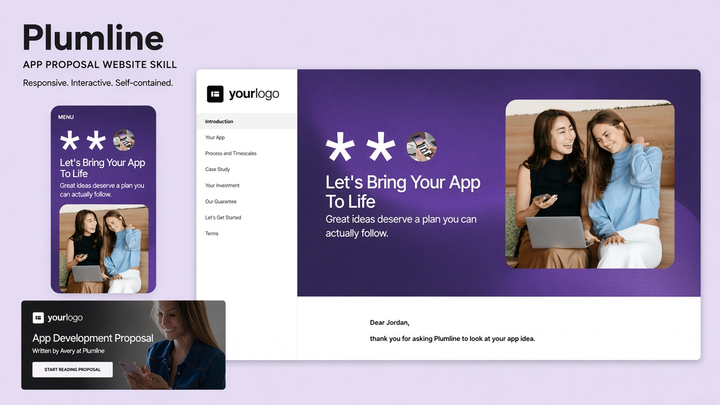
Structure is what the client is actually buying
Consulting is bought on confidence: the client is paying for judgment they cannot fully evaluate in advance. A consulting proposal therefore has a different job from a product quote — it must frame the problem correctly, show a method, and make the engagement's boundaries explicit, all before any work exists to point at. The Skillux Proposal skill generates that document as a standalone proposal website in Claude, Cursor, or Codex: objectives connected to approach, deliverables, stages, and fees, with sample commercial terms carried through instead of improvised per client.
Last updated 2026-11-07
From the live Skillux catalog
1 matching skill. Check each listing for its contents and license.
Put the skill to work
Start from the situation the client already recognises: the cost, delay, error rate, or missed opportunity that prompted the conversation. A proposal that opens with your firm's biography asks the client to do the connecting work. The Proposal skill's structure connects the client's objectives directly to your approach and deliverables, so the reader can follow the line from problem to fee without re-reading.
Break the engagement into named phases — diagnostic, design, implementation support is the classic consulting shape — and give each phase its deliverables, its duration, and what 'done' looks like. Acceptance criteria per phase do double duty: they reassure the client, and they stop a phase from expanding silently when the findings turn out to be interesting.
Consulting is sold as fixed-fee phases, day-rate blocks, or monthly retainers, and clients compare the shapes as much as the totals. The Proposal skill presents alternative packages and optional add-ons with one-time, monthly, and annual totals kept separate, so a retainer reads as a retainer and a fixed phase fee reads as a commitment with an end. State taxes and external costs explicitly; a surprise expense line is the fastest way to lose a procurement team's trust.
Confidentiality, IP in the deliverables, who may rely on your recommendations, how changes and extra work are charged, and what support exists after the final phase. The skill includes sample terms for payment, changes, acceptance, IP, confidentiality, and support as a starting point for negotiation. They are samples, not a contract — confirm jurisdiction and engagement details and get local legal review before relying on them.
Review the Proposal skill's output examples and feature set on the hub page, then install the complete pack into your agent. English is the default, with US and UK market conventions supported — relevant when your terms and fee presentation need to match the client's market.
Supply the client's problem as they state it, your phase structure, the deliverables and acceptance criteria per phase, and your confirmed fees for each engagement model you want to offer. Missing commercial or legal details are flagged as open questions, not filled in with plausible inventions.
The client receives a standalone proposal website — cover plus structured document, readable without JavaScript and on mobile. You keep the source configuration, theme record, media usage records, and verification status alongside it, so the next proposal for the next client starts from a known-good base.
The client's problem and objectives, your approach broken into phases, deliverables and acceptance criteria for each phase, a timeline, the fee structure for the engagement models on offer, and terms covering payment, changes, IP, confidentiality, and support. Credentials belong in support of the problem framing, not in place of it.
Long enough that every commitment is unambiguous, short enough to be read in one sitting. For most independent and boutique consulting engagements that means a focused document the client can finish in fifteen minutes: the structure matters more than the page count. The proposal website format helps here — a contents rail lets a finance reader jump straight to fees while a sponsor reads the approach in full.
Offer the model that matches the work's certainty. Fixed fees suit phases with definable deliverables; retainers suit ongoing advisory access where the questions arrive unpredictably. Many consultants present both — fixed-fee phases for the defined project, an optional monthly retainer for what follows — which is exactly the package-plus-add-on structure the Proposal skill renders, with the recurring totals kept visibly separate.
No to the first: the skill is built for client service proposals — scope, fees, stages, and terms for an engagement — not investor pitch decks or equity narratives. For a formal RFP, the generated proposal can carry your substantive response, but mandated response formats, compliance forms, and submission portals still have to be handled in the buyer's own process.