Free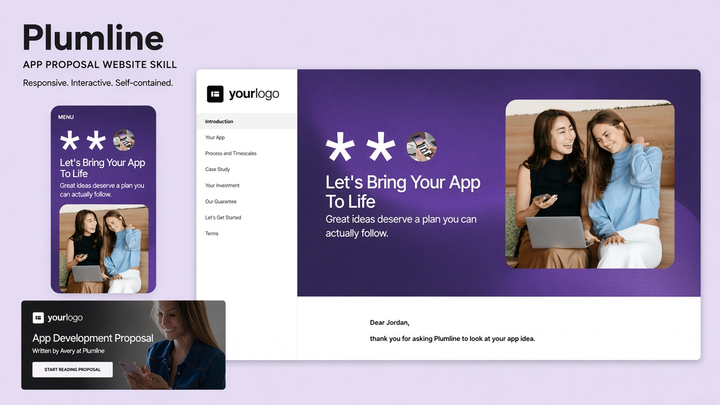
Stop quoting. Start proposing.
The freelance proposal is usually lost before it is written: a prospect asks 'how much?', gets a number in an email thread, and compares it against three other numbers with nothing else to go on. A generator changes the artefact, not just the speed — the Skillux Proposal skill turns a short brief into a standalone proposal website with a cover, your scope and exclusions, delivery stages, fee packages the client can explore, and sample terms, generated inside Claude, Cursor, or Codex. You brief it like a colleague; it asks about anything missing instead of inventing your fees.
Last updated 2026-11-07
From the live Skillux catalog
1 matching skill. Check each listing for its contents and license.
Put the skill to work
Your fee is the only part of an email quote the client can compare, so it becomes the whole comparison. A structured proposal reframes the decision: objectives first, then scope, stages, and deliverables, with the fee arriving after the client understands what it buys. That ordering — which the Proposal skill's document structure enforces — is worth more than any discount you were about to offer.
Studios absorb scope creep across a team; freelancers absorb it personally, at night. State what is not included — extra revision rounds, copywriting, photography, rush delivery, source-file formats you do not supply — in the proposal itself. The skill gives exclusions a defined place next to the scope rather than in an awkward follow-up email after the client has assumed the opposite.
Offer the core engagement as one clear package, then optional add-ons — ongoing support, an extra deliverable, a faster timeline — that the client can include or drop. The skill renders these as explorable packages with one-time and monthly totals kept separate. Clients who can configure a proposal say yes more easily than clients who can only accept or reject a single figure, and the add-ons they pick are work you would otherwise have given away.
Payment schedule, change pricing, IP transfer on final payment, confidentiality, and what happens when feedback is late — a freelancer needs these in writing more, not less, than an agency does. The skill carries sample terms through the document as a negotiation example. Confirm the details for your jurisdiction and get local review before relying on them; a marked draft with open questions is the honest intermediate state when details are missing.
The hub page walks through the Proposal skill's output — cover, document, and investment sections — with real examples. Install the complete pack into Claude, Cursor, or Codex before you need it, so the next enquiry is a brief, not a setup session.
Client, objectives, scope and exclusions, stages, your confirmed fee, timeline. That is the whole input. The skill adapts its theme and imagery to the service you are selling, so a photographer's proposal and a developer's proposal do not come out wearing the same clothes — and mandatory brand requirements you supply take priority.
Anything you left open comes back as questions or a clearly marked draft — suggested fees or credentials are never silently presented as confirmed facts. Resolve the flags, verify the totals, and send the client the proposal website. When they accept and the work begins, the free Invoice skill handles the billing documents on the same terms you proposed.
A template is a fixed document you overwrite: same pages, same design, your old client's details waiting to be accidentally left in. A generator builds the document from a brief each time. The Proposal skill produces a standalone website for the specific engagement — cover, structured document, explorable fee packages, and a theme matched to the service — and asks about missing details instead of reusing stale ones.
That is the point of the skill's bundled composition: one editorial layout, adapted automatically in palette, imagery, and motifs to the service being sold, across its industry directions. You do not pick a palette or write image prompts. If you have brand assets or non-negotiable brand rules, supply them and they take priority.
No. Acceptance records the client's choices and amounts as a local draft file; nothing is sent, signed electronically, or paid through the proposal site. Keep using your normal contract route for signature and the Invoice skill for billing — the proposal's job is to win the agreement, not to process it.
Brief what you know. The skill asks for the missing business information — fees, timeline, client details — and can produce a clearly marked draft plus a questions file when things remain open. That is deliberate: a proposal with invented fees or credentials is worse than a draft that shows its gaps.