Free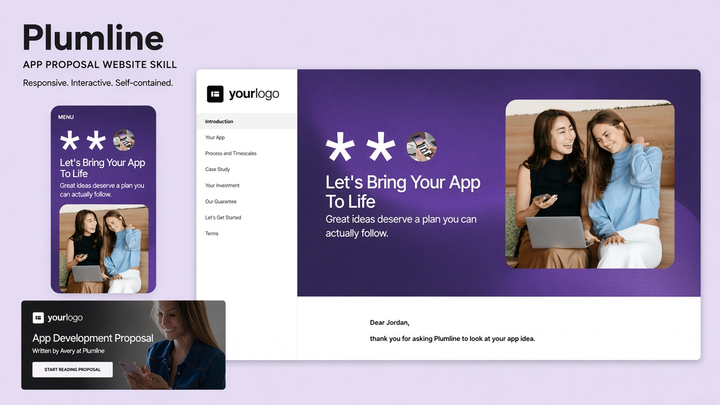
The proposal is the first deliverable
Most web design proposals fail on structure, not design talent: the client cannot tell what is included, what is not, when they will see what, or what the total commits them to. A template fixes the structure. The Skillux Proposal skill goes one step further — it takes the same sections and generates a standalone proposal website in Claude, Cursor, or Codex, with a full-screen cover, a structured document your client reads in the browser, and a visual theme matched to the service you are selling.
Last updated 2026-11-07
From the live Skillux catalog
1 matching skill. Check each listing for its contents and license.
Put the skill to work
Open with what the new site is for — enquiries, bookings, recruitment, credibility with a specific audience — in the client's terms, not a list of your services. Every later section should trace back to these objectives; if a proposed page or feature serves none of them, it is scope waiting to be cut or charged for.
Name the pages, templates, integrations, and content responsibilities you are including, then name what you are not: copywriting, photography, illustration, hosting, ongoing SEO, third-party licence costs. Exclusions are where web design projects lose money, because an unstated assumption ('the client will write the copy') becomes your unpaid task at launch. The Proposal skill gives scope, exclusions, delivery stages, and acceptance criteria each a defined place in the document.
Present a fixed project fee with the stages it covers, then separate the recurring part — a care plan, hosting management, or support — so one-time and monthly totals never blur into one misleading number. The Proposal skill renders fees as packages with optional add-ons the client can explore, with taxes and external costs stated explicitly instead of buried in a footnote.
Cover payment milestones, how changes are priced, what acceptance means at each stage, who owns what, and what happens to the timeline when feedback or content is late. The skill ships sample terms for these points as a negotiation starting point — they still need local review before you rely on them for a real engagement.
The hub page shows the Proposal skill's actual output — cover, document, and investment sections — and the industry directions it supports. Install the complete pack into Claude, Cursor, or Codex and keep its configuration and theme files together.
Give the skill the client, the objectives, your scope and exclusions, stages, confirmed fees, and timeline. You do not choose a palette or write image prompts: the skill uses its bundled editorial composition and adapts the theme and imagery to the service, with any mandatory brand requirements taking priority.
If details are missing, the skill asks — and can produce a clearly marked draft with a questions file rather than inventing fees or credentials. Resolve anything flagged, check the fee totals and stage dates, and send the client the proposal website.
The client's objectives, your proposed approach, a scope list with explicit exclusions, delivery stages with acceptance criteria, a timeline, fee packages with recurring costs shown separately, and terms covering payment, changes, IP, and support. If any of these is missing, the client fills the gap with an assumption — usually the cheapest one.
A Word or PDF template gives you fixed pages to overwrite, and the design is whatever the file shipped with. The Proposal skill generates a standalone website for the specific engagement: a full-screen cover, a structured document with a contents rail and mobile navigation, interactive fee packages, and a theme matched to the service. Clients read it in the browser, on a phone, without opening an attachment.
Fixed-fee packages are easier for clients to approve because the commitment is a number, not a meter. If parts of the work are genuinely unknowable — legacy content migration is the usual case — carve them out as a separately priced phase or a capped estimate rather than leaving the whole proposal hourly. Whichever model you choose, tie payments to stages so neither side carries the full project risk.
No. The acceptance step produces a local record of the client's choices and amounts; it does not complete an electronic signature, send anything, or take payment. Use your normal contract and invoicing route for those steps — the Skillux Invoice skill covers the billing documents once the work is underway.